

WHAT IS A LIPOSOME?
THE LIPOSOMES
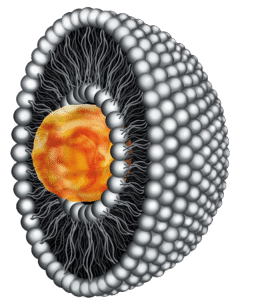
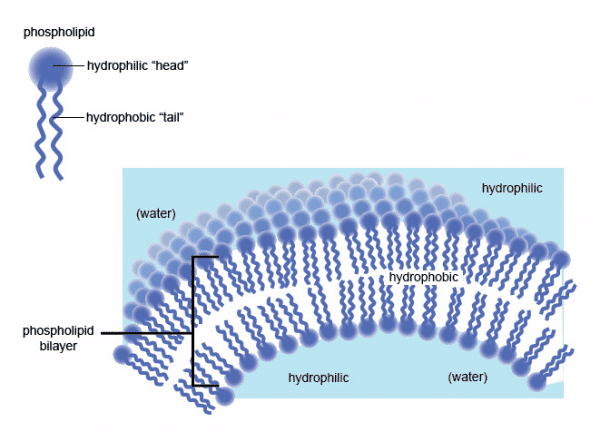
Liposomes are extraordinarily small spherical vesicles composed mainly of phospholipids (in our case, non-GMO sunflower phosphatidylcholine) organized in a bilayer, containing an aqueous phase inside, and suspended in an external aqueous phase.

WHAT ARE LIPOSOMES USED FOR?
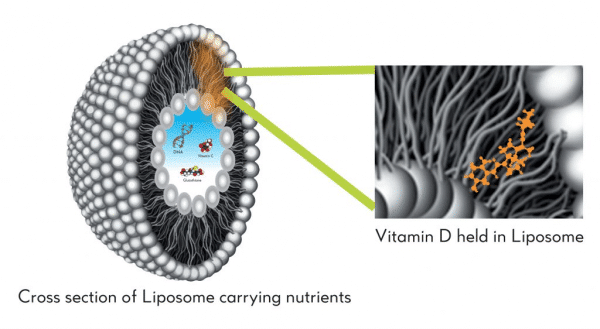
The unique structure of liposomes provides the ability to trap water-soluble molecules (such as vitamin C, vitamin B12, vitamin B,…) in their inner core, and fat-soluble molecules (such as curcumin and Vitamin D, Vitamin K) within the hydrophobic bilayers;
The characteristics of liposomes modify the pharmacokinetics of the encapsulated active ingredient, improving solubility, bioavailability and stability in vitro and in vivo.
In this way, the substance remains intact, delivering the active component directly to the cell.
Liposomes are mainly used to transport active ingredients in the most selective way possible, thus increasing efficacy and decreasing side effects.
They are also used to prolong the action, improve absorption, penetration, diffusion, or to stabilize the active ingredient.
PARTS OF A
LIPOSOME
These three factors make liposomes so attractive for drug or nutraceutical delivery.
THE VESICLES
These bubbles (vesicles) can be filled with substances such as vitamin C, glutathione or even drugs. The hydrophilic active ingredient is incorporated inside the liposome (water-soluble vitamins (B vitamins, Vitamin C, Glutathione …) and the lipophilic ones in the liposomal bilayer (liposoluble vitamins such as vitamin A, D, E, K, Curcumin …).
LOS FOSFOLÍPIDOS
They are natural lipids that have the same composition as human cell membranes. This is the reason why liposomes can easily bind to cells and deliver the active components directly to the place where they are needed: the cells, and phospholipids are themselves an important supplement. They protect the encapsulated active ingredients from any aggression from the digestive system.
THE SIZE
Liposomes are microscopic particles, which improves absorption.
HOW ARE LIPOSOMES FORMED?
IMPORTANCE OF QUALITY
Phospholipids are combined with water and energy is applied in a controlled process using sonification or an ultra-turrax.
FOR WHICH PERSONS ARE THEY RECOMMENDED?
Advanced liposome technology provides an alternative and additional clinical prescription option.
HOW ARE THEY FORMED?
STRUCTURE OF THE
LIPOSOMES
MANUFACTURING QUALITY
QUALITY IN THE MANUFACTURING
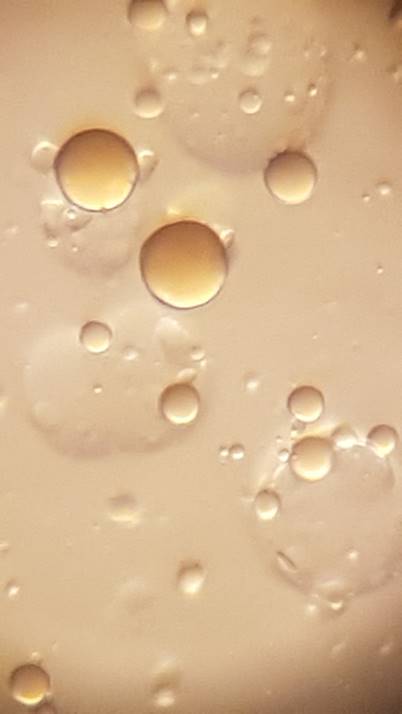
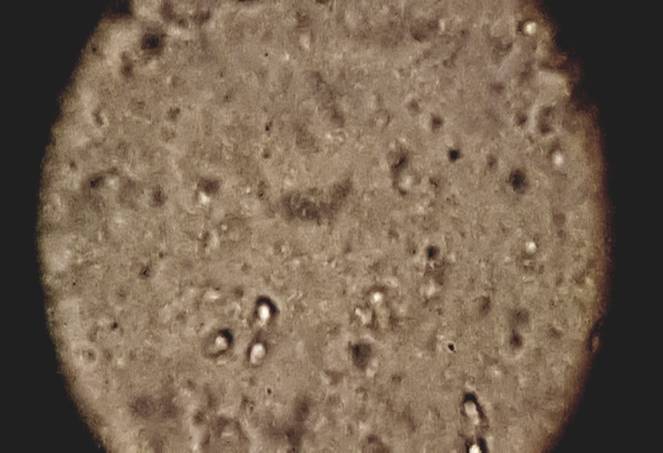
To make liposomes it is required:
- Very high quality phosphatidylcholine (PC).
Purified water. - Significant levels of energy.
- And the high quality active ingredients to be encapsulated.
Phospholipids are combined with water and energy is applied in a controlled process using sonification or an ultra-turrax.
Lipid vesicles will form in single or multiple bilayers, separated by water molecules.
This process is controlled to create particles small enough to be easily absorbed into the bloodstream.
Our liposome solutions have a particle size distribution (liposome) of 100-500 nm.
Liposomes are unstable, this is one of the biggest challenges in the process. We use stabilized liposomes.
Liposomes, vitamin C, glutathione, etc. are extremely unstable in the presence of oxygen.
We make every effort to produce our products in the absence of oxygen.
CureSupport has specialized in the development of a high performance liposomal supplement such as Vitamin C, Fat Soluble Vitamin (A, D, E, K), Water Soluble Vitamins (B-Complex) and phytonutrients.
Therefore, they are absorbed more efficiently:
– They are absorbed more efficiently.
– They are designed to deliver their active components directly to the cell.
– They have a price advantage compared to most supplements, while at the same time optimizing absorption, with no waste.
HOW ARE LIPOSOMES ABSORBED?
LIPOSOMAL ENCAPSULATION TECHNOLOGY (LET)
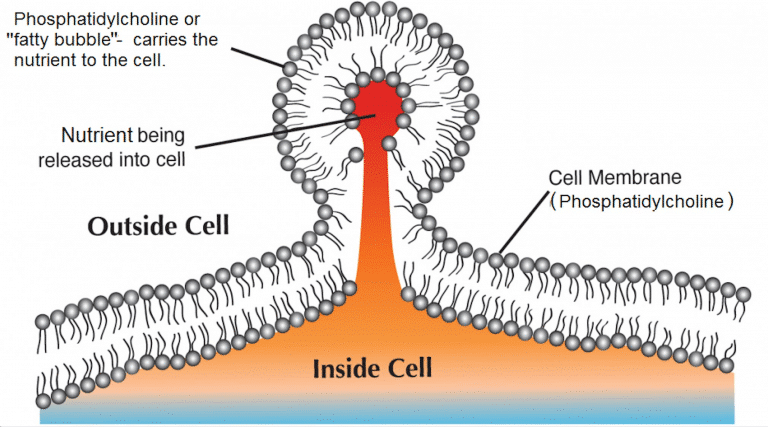

The liposomal delivery system has many advantages over traditional oral ingestion.
Mechanisms
of Absorption
TRADITIONAL ORAL absorption
ORAL absorption LIPOSOMES
Phospholipids are impermeable to various digestive juices. This makes liposomes the perfect delivery system for acidic and enzyme-sensitive substances.
Once the liposome has reached the small intestine, there are different proposed absorption mechanisms:
- The absorption of whole liposomes by the M-cell in Peyer’s patches.
- The fusion of the liposomal lipid bilayer with the intestinal plasma cell membrane, this would facilitate the release of the active principle trapped in the cytoplasm.
It is absorbed by enterocytes in the intestinal villi. Within the enterocytes, liposomes are incorporated into chylomicrons. - Together, they travel through the lymphatic system, bypassing the liver (portal circulation) in the subclavian vein.
INTRACELLULAR
Another great advantage of the liposomal delivery system is the way it releases nutrients intracellularly.
It can do this by different mechanisms:
- ENDOCYTOSIS
Endocytosis is a process in which the cell engulfs the liposome forming a vesicle surrounded by a membrane called endosome. - ADSORPTION
The liposome wall attaches to the cell and releases its contents into the cell. - FUSION
The liposome fuses with the cell membrane releasing its contents. - LIPID EXCHANGE
The contents of the liposome and the cell exchange their lipid content.
ADVANTAGES OF DELIVERY SYSTEMS
- Increases bioavailability of active substances through improved water solubility.
- Ability to encapsulate both water-soluble (water-soluble) substances and fat-soluble (fat-soluble) active ingredients.
- Protection for sensitive active substances from degradation in the gastrointestinal tract.
- Reduction of gastrointestinal side effects.
- Composed of natural lipids that have important advantages by being biocompatible with human tissues; Phospholipids are an active ingredient by themselves.
- Oral liposomal liquids allow flexible dosing and can be combined for individualized prescription.
LIPOSOMAL LIQUID FORMS
- COMFORT: For those patient populations where capsules or tablets are not suitable such as children, elderly and people with swallowing difficulties.
- EFFECTIVE: Pure and high quality liposomes are formulated to provide effective doses of active substances.
- DOSAGE: They allow adjusting dosage according to the health professional’s criteria.
ADVANTAGES OF DELIVERY SYSTEMS
FOR WHICH PERSONS ARE THEY MAINLY RECOMMENDED?

SUGGESTED USE
Advanced liposome technology provides healthcare professionals with an alternative and additional clinical prescribing option.
Especially interesting for:
- Chronic patients where intestinal absorption may be compromised:
- Patients with sensitive gastrointestinal tracts.
- Elderly patients
- Inflammatory bowel disease
- Patients with dysphagia
- Those requiring high therapeutic doses